Catholicism: A Journey to the Heart of the Faith
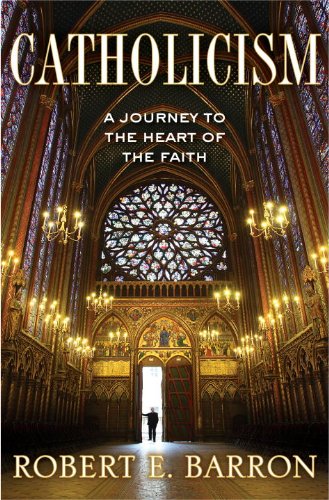
What is Catholicism? A 2,000-year-old living tradition? A worldview? A way of life? A relationship? A mystery? In Catholicism Father Robert Barron examines all these questions and more, seeking to capture the body, heart and mind of the Catholic faith.
Starting from the essential foundation of Jesus Christ’s incarnation, life, and teaching, Father Barron moves through the defining elements of Catholicism--from sacraments, worship, and prayer, to Mary, the Apostles, and Saints, to grace, salvation, heaven, and hell. Whether discussing Scripture or the rose window at Notre Dame, he uses his distinct and dynamic grasp of art, literature, architecture, personal stories, theology, philosophy, and history to present the Church to the world.
Paired with his documentary film series of the same title, Catholicism is an intimate journey, capturing “The Catholic Thing” in all its depth and beauty. Eclectic, unique, and inspiring, Father Barron brings the faith to life for a new generation, in a style that is both faithful to timeless truths, while simultaneously speaking in the language of contemporary life.
Reviews (191)

Great book!
I really enjoyed this book. I am a non- catholic and bought this book just to see why Catholicism is different from protestant. Huge eye opener for me. It is well written and concise. He makes his points clear and understandable for everyone. He explains why Catholicism has its traditions and sacraments and where they are tied to in the bible. I feel like Father Barron was speaking to me sometimes and I know this book has helped to fill some spiritual gaps in my life that I have felt while attending my local church. I have since bought his other book "Paradoxes" and "Waking up Catholic" by Chad Torgenson". This book started a spiritual reawakening for me and set me on a new path. I pray it will for you too.

4+++
I struggled a bit through the intro & beginning chapter...but, got 'taken' from there. As a poor excuse for a Catholic, I bought this book to see if It could remind me of my youthful Faith (and Joy). At times, it brought me to halt - striking uncomfortaby close to home! It detailed the beauty of the history of the Catholic church from it's beginning with Jesus' authorization ' thou art Peter and upon this rock, I will build my church.......'. I would have liked more follow through on some of the subjects raised. (But, only God can be all things to all people!) …&, I guess that's why we call it Faith. It is a celebration of the Articles of Faith....you probably won't be struck by lightening or have all doubts removed but, you may find yourself in a better place for having read it!

This is an elegantly written apologia for Catholicism.
This is an elegantly written apologia for Catholicism. Barron's point, I believe, is to restore the sense of Catholicism as a culture in itself. As a culture, Catholicism has a depth and breadth that cannot be reduced to a handful of dogmas, but, rather, must be experienced as a total experience. Barron invites us to see Catholicism as he sees Catholicism, namely rich and beautiful and, ultimately, mysterious. However, Catholicism is a culture that is a religious faith. Accordingly, Barron approaches the culture through the faith, starting with the distinctive elements of Catholicism, but unfolding them through reflection on history, art, and literature. Thus, Barron begins with the revelation of Jesus and His mission; explores the theology of God's existence with Anselm and Aquinas; considers Marian doctrines and the missions of Peter and Paul; reflects on the mystery of the church; and discusses the communion of saints, the sacraments and the last things. Barron is an insightful observer; he can invariably take the normal and quotidian and point out something overlooked by most people. His insights are well worth the price of admission. Consider this example: "How strange that we believe in the church. In the Nicene Creed, Catholics profess their faith in the Father, the Son, and the Holy Spirit, the three divine persons, and that seems reasonable enough. But then they proceed to declare their belief in “one holy catholic and apostolic church.” Does this not amount to the conflation of Creator and creature? Is it not effectively blasphemous to announce one’s faith in a human institution? To answer these questions is to come to the heart of the Catholic understanding of the church, for Catholics hold that the church is not merely a human organization, simply a coming together of like-minded people, a community of purely worldly provenance and purpose. Rather, the church is a sacrament of Jesus and, as such, shares in the very being, life, and energy of Christ. According to the inexhaustibly rich metaphor proposed by Saint Paul, the church is the body of Jesus, an organism composed of interdependent cells, molecules, and organs. Christ is the head of a mystical body made up of everyone across space and time who has ever been grafted onto him through baptism." All true, all said many times, and, yet, it is interesting. It is strange to think that we believe "in" the Catholic - or, for Protestants, catholic - church in the same way that we believe "in" Jesus. We simply don't tend to believe "in" things these days, perhaps, or, perhaps, we are so nominalist that we can no longer believe that "the church" has a dimension more than its finite members. Another example: "We hear that in the wake of this exchange there was a mass defection among Jesus’s followers: “Then many of his disciples who were listening said, ‘This saying is hard; who can accept it?’ ” (Jn 6:60) and “As a result of this, many [of] his disciples returned to their former way of life and no longer accompanied him” (Jn 6:66). It is fascinating to note how often in the history of Christianity the teaching concerning Jesus’s presence in the Eucharist has been a church-dividing issue, a standing or falling point. Plaintively, Jesus asks his remaining circle of followers, the twelve: “Do you also want to leave?” (Jn 6:67). What follows is John’s parallel to Peter’s confession of faith at Caesarea-Philippi: “Master, to whom shall we go? You have the words of eternal life. We have come to believe and are convinced that you are the Holy One of God” (Jn 6:68–69). Speaking for the others, Peter confesses that what Jesus has said about the Eucharist is true, and he ties that confession to a declaration of Jesus’s sacred identity. From a Catholic point of view, this coming together of faith in the Incarnation and faith in the real presence is of great significance, for the Eucharist is nothing other than a sacramental extension of the Incarnation across space and time, the manner in which Christ continues to abide, in an embodied way, with his church. At this crucial moment in Jesus’s public ministry, Peter got this, and he spoke his conviction on behalf of the core group of Apostles. It is the Catholic faith that Peter, down through the ages, has continued to get it." Compare this insight with Jerry Walls' banal "argument from political correctness" in

Makes you proud to be Catholic
Bishop Barron has done nothing less than write a love letter about that Catholic faith that is inspiring and motivating at the same time. He goes through the ages and displays with great beauty how deep the Catholic faith is, how it has been manifested not only in the faith itself and the communion of saints, but in the art, architecture, and writings that have been a part of it for 2000 years. As some others have pointed out, the ending of this book is beautiful, as is his treatise of 1 Corinthians 13, both of which challenge you to keep your eyes dry as you read. This book is not by any means a complete history of the faith, nor is it a full description of our theology and beliefs. However, I do believe it is approachable for readers of any faith or background desiring to learn more about the Catholic Church. Indeed, I would recommend it as a persuasive work that can be used to hold onto any teetering Catholics, as well as to draw anyone into the faith who may have considered joining.

A Summary of What it Means to be a Believing Catholic
Bishop Robert Barron in his book, Catholicism: A Journey to the Heart of Faith, offers a readable summary of Christian beliefs found in the Bible and Revelation: on what it means to know God who created us with love, understand God's revelations, worship God in the community called Church, experience God's presence in the sacraments instituted by His son,Jesus Christ, identify sin in themselves and accept the forgiveness of God, be inspired by imperfect people who would later be declared Saints, and arouse in the reader a desire to be holy and to live one's life in preparation of the Beatific Vision of God in Heaven for all eternity. Readers will have questions and these are signs they have read a good book and that their faith seeks understanding. The book should be a considered a reference book useful for parents who want to instruct their children on the foundations of Christian faith and to have answers when questioned on why they believe in God, his Son, Jesus Christ, and the presence of the Holy Spirit. Bishop Barron explains the truths of faith both as a reassurance for believers and as a proclamation of witness to the world. Father DMcL

Bringing Thinking to Faith
Biases up front: I am currently in RCIA, so I am studying to become a Catholic, and am looking at this book through that lens. When you consider that 2011 is when the BBC documentary about clerical abuse came out, after year after year of terrible revelation after terrible revelation, you might be surprised that anyone would write a book defending the Catholic Church. But Bishop Robert Barron did so much more than respond to a crisis, in “Catholicism,” he reminds us of the power and light of God’s church, even while acknowledging that it is held in earthen and often unworthy vessels. This book was, literally, a godsend for me in my study of the faith. Bishop Barron explores the elements of Catholicism that make it unique: the concern with Mary, the veneration of saints, confession, purgatory, and even papal infallibility (which is not at all what it is presented to be in secular media). More than that, though, through this book, he lives the evangelizing style he speaks of so passionately in his videos for the Word on Fire Ministry - the beauty of the Christian life, then the truths that lead to to beauty, then the laws that lead to truth. So many of us get that precisely backwards and I know it’s been a stumbling block that I have encountered and have given in my own life. For those of a questioning bent, including me, Bishop Barron arrays arguments and evidence on his side and, unlike so many religious texts that seem to think faith just needs to pop up out of nowhere, makes a compelling case for God and for God’s church. He uses an array of rhetorical styles: reasoning, example, allegory. All of it comes back to the objective truth of God’s existence and his love for us, and the sum effect of the work is powerful, especially if you like to spend time thinking over arguments and considering reasoning. His intellectual bent means he doesn’t touch as much upon subjects like the Liturgy of the Body, so you’ll need to go elsewhere to look for thinking on those topics. But in making a forceful and reasoned case for the Trinitarian God of Scripture, Bishop Barron puts paid, in his argument and in the sheer example of his text, to the idea that we shut off our thinking when we turn to God.

Just as good on Audible! Catholicism's Culture of Beauty
I bought this book with the Audible Narration added. I was concerned that with a book so focused on beauty and art, something would be lost in the audio. However, I found myself glued to my headphones. Bishop Barron has a wonderful voice for the audio format, speaking clearly and with good cadence. In addition, the content of the book also provided a new way of looking at Catholicism and the culture of beauty which surrounds it. Although I knew in the back of my head somewhere that many great artists created religious works, in never quite sunk in that the religiosity is exactly what drove the beauty of those great works. I especially enjoyed how he integrated the lives of the various saints, interweaving beauty and morality with religion in an articulate and exciting way.

A Book Everyone Should Read, A Book of God's Incredible Love
Anyone who seeks existential truths will benefit greatly from this book, especially those who seek them in the Bible. But this book is not an ordinary study of the Bible, or of theology. Nor does it focus on the history, the philosophy, or the psychology of religion. And it isn't a treatise on religion and science, on anthropology, archeology, ancient languages, art, literature, sociology, government, mysticism, justification, ethics, morality, or any one thing. Rather, it is a seamless integration of all these things and more, holistically rolled up in a masterful way, to discuss and explain the enormous consequences of the Incarnation, which has brought truth, hope and joy to everyone in all circumstances. It is a smooth, coherent piecing together of all facets of religion for laymen of any faith to see in totality, perhaps for the first time, the breathtaking "Big Picture" of our loving creator Jesus Christ. This Big Picture is ingeniously presented in the greater part of the book. Towards the end there are discussions, possibly of primary interest to Catholics, on the Mass and the Eucharist, followed by intriguing stories of four relatively modern day Saints. Returning to topics of universal interest, the last two chapters contain a marvelous description of the distractions that prevent us from approaching God more closely, followed by an inspiring discussion of heaven and hell. Finally, there is a brief, separate section (coda) that summarizes all that the author has presented: God's love in all things, most profoundly expressed in Jesus, and the enormous, loving help to us all afforded by Catholicism. So again I say, anyone striving to understand the why and wherefore of mankind's existence will be greatly enlightened and inspired by this extraordinary book. It is not simply a rehash of classical Catholic intellectual and spiritual traditions. It is a book for anyone longing for answers to the Big Questions. Personally, this book has helped me to know better who and why I am and to try to be in touch with God's love, through Jesus, all the time, not just on sporadic occasions of intellectual or emotional excursions from self preoccupation. It is changing my priorities. Martin Fricke, Ph.D. (physics)

God's Gift to Catholics -- Robert Barron
I really love Fr. Barron. I have been listening to his homilies on Word on Fire, and I loved this book. Right after I finished it I started reading it again, because he makes you think and in different ways and I thought I would get even more out of it if I read it again. I loved reading about Peter and Paul, and the Saints, and of course Jesus. I took at 45 year break from religion and am still in the process of becoming a Catholic, so this book is great for me. But many non-Catholics would enjoy it too, as long as they have an open mind. His writing has life because he is very profound but he also captures the spiritual so well.

Catholicism - To Book or Not To Book
Confession #1: I came into this book review pretty biased. Why? Fr. Robert Barron's Catholicism DVD series - all ten episodes - are some of my absolute favorite (and most watched) videos that I own. Confession #2: Given how rich and encompassing the video series is, I was not sure of the necessity of the Catholicism book. Conclusion: I was wrong. I admit it, and I do not do this often, but... I was very wrong. The book is a perfect companion to the series, and stands alone as an exemplary reflection and teaching of the Catholic faith. Here are my Top 5 Reasons to Consider (seriously consider), adding Catholicism: A Journey to the Heart of the Faith to your library: 1.Catholicism is a fantastic aide for anyone leading discussions of the Catholicism DVD series. 2.The first thing I noticed as I read Catholicism, how rich in Scripture references it is. In my opinion, two of the greatest misconceptions about Catholics - our faith is not bible based and Catholics do not read (or study) God's word. That is just not true, and was evident in Fr. Barron's book as I had counted over 10 Scripture references before I finished page 6! 3.My experience in leading groups viewing and discussing the Catholicism DVD series, has taught me sometimes people are overwhelmed by the amount of information offered to them each episode. Faced with so much new and compelling information you can find easily yourself either feverishly writing down notes - trying to recall snippets of Fr. Barron's glorious insights, or lost in the stunning images. Regardless of how you miss something, Catholicism catches you up to speed because - in Fr. Barron's words - "this book is chockablock with stories, biographies, and images." (pg. 7) 4.Although it pains me to publicly admit this, it is the truth. Fr. Barron's vocabulary is not quite as pedestrian as mine. There are many times throughout the video series, that I need to pause and Google a definition or more. This pause and explore method is fine when I am alone, but not conducive to group viewing. Catholicism (the book), not only allows me a self-controlled pace to decipher some of Fr. Barron's words but also provides me the often needed spelling of said words! 5. Simply put, it is just really good, and a very worthwhile read.


Comments
Post a Comment